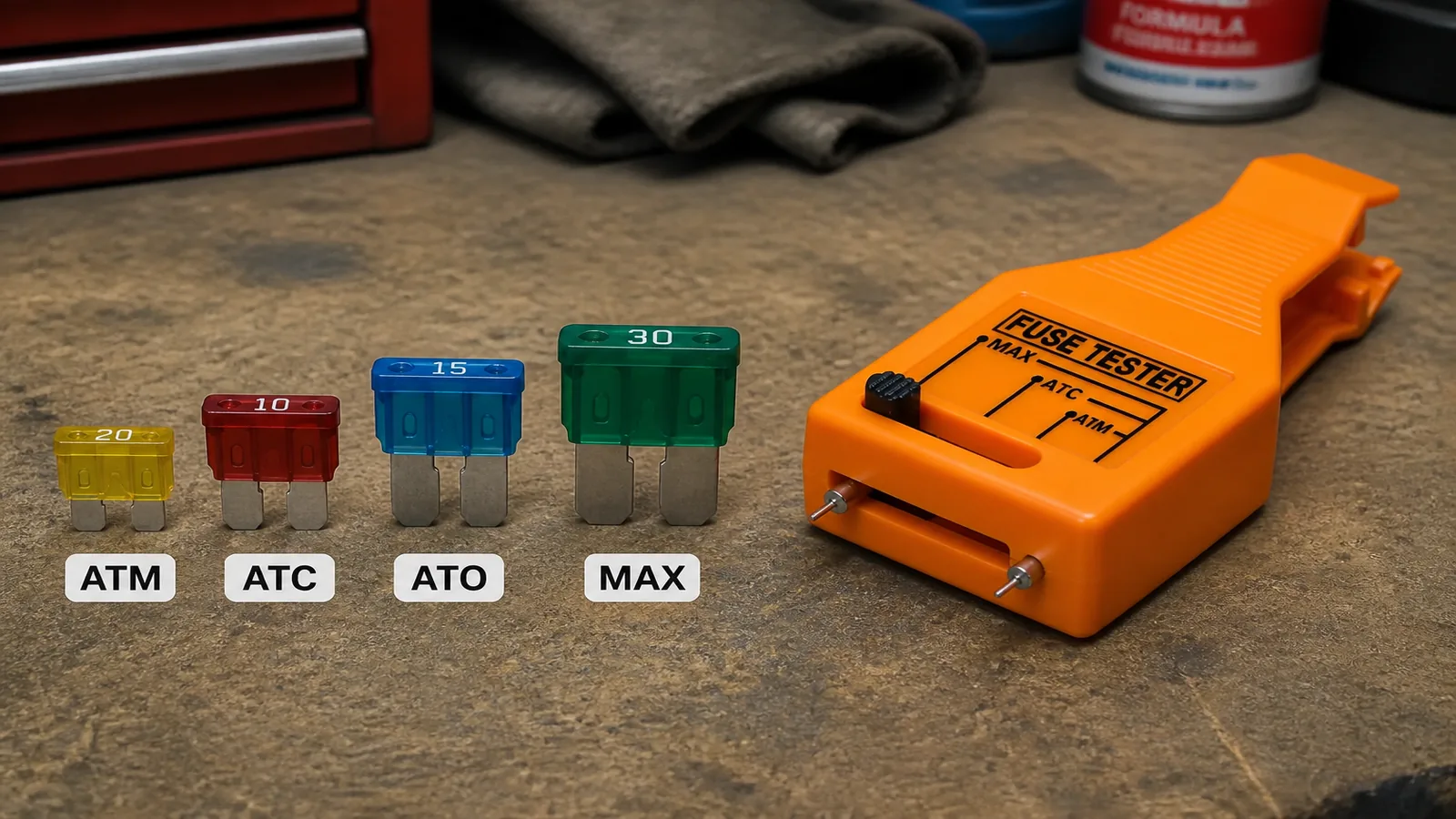
How to Identify Car Fuse Size before Buying Tester
Short answer: how to identify car fuse size before buying tester should be judged against the actual task, compatibility limits and the result you need—not against a generic feature count. Treat the task as a sequence: confirm the starting condition, check compatibility, make one controlled change, then record the result before moving on.
Who this guide is for
- You want each claim tied to a check you can repeat before ordering.
- You are comparing fit, limits and value rather than choosing on a headline claim.
- You need a practical answer that respects the vehicle maker's instructions and the limits of DIY diagnosis.
If these needs sound familiar, use the checks below in order. If they do not, start from the compatibility table rather than assuming the same recommendation applies.
A direct answer to how to identify car fuse size before buying tester
The current listing identifies the product as ATOATC 2-in-1 automotive fuse tester puller for standard ATO/ATC blade fuses. The practical boundary is equally important: and explicitly not compatible with mini or low-profile fuses. If that description and boundary match the task in front of you, continue to the fit checks below; if either one does not match, this is the wrong route regardless of price.
Start with the job, not the product name
Treat the task as a sequence: confirm the starting condition, check compatibility, make one controlled change, then record the result before moving on. Before opening several product tabs, write a one-sentence success test: what must fit, what must be measured or completed, where it will be used, and what would make the result unacceptable. This is especially important for how to identify car fuse size before buying tester, because similar search labels can hide different dimensions, connections or operating limits.
Separate requirements into three columns: must fit, must perform and must be manageable. The first covers physical and technical compatibility. The second covers the result. The third covers setup, readability, storage and how easily the intended user can repeat the task.
Current product facts to verify
The current listing describes the product with the following points. Check the live page before ordering; these are listing facts, not independent test results:
- ATOATC 2-in-1 automotive fuse tester puller for standard ATO/ATC blade fuses
- an adjustable twin-pin light-up probe for checking an energised fuse in place
- with extraction jaws on the reverse end for pulling the fuse from a tight box rated for 6V–24V DC cars
- vans and lorries
- UKCA/RoHS compliant
- and explicitly not compatible with mini or low-profile fuses
| Product page | ATOATC 2-in-1 ATO Fuse Tester & Removal Tool UK |
|---|---|
| Live detail price | £19.19 when checked for this guide; recheck before ordering |
| Guide focus | How to Identify Car Fuse Size before Buying Tester |
| Best suited to | research and comparison |
A repeatable decision process
- Define compatibility. Record the size, interface, range, material or environment that cannot be compromised.
- Check the product detail page. Look for an explicit match. Do not infer compatibility from a photograph or a similar model name.
- Rank limits before extras. A limit that rules the product out matters more than several convenience features.
- Plan the first use. Decide how you will confirm setup and recognise a plausible result before relying on it.
- Keep a return route. Save packaging until fit and basic operation have been checked without modifying the item.
This process is deliberately conservative. It reduces rework when time, confidence or budget is tight, and it makes a later comparison easier because every candidate has been judged against the same list.
Questions that expose a poor fit early
- Does the stated size, connector or operating range match the item already in front of you?
- Is the product itself being sold, or only an accessory, bracket, probe, cable or case?
- Which claim is a measured specification, and which is only a general description?
- Can the intended user set it up, read it and repeat the task without an avoidable workaround?
- If the first result looks wrong, is there a sensible check before concluding that the product or the underlying system has failed?
Use the result responsibly
Stay within the stated electrical range, follow the vehicle or equipment maker's procedure, and stop if the job requires work on an exposed or unfamiliar live circuit.
Build a small topic path
One page should answer one intent. Continue with the related route that matches your next question rather than treating every article as another version of the same buying guide.
Check the live product detail
The product page is the final source for compatibility, price and availability. At this run it shows £19.19; check it again before ordering.
View the Atoatc product — £19.19Frequently asked questions
What should I check first?
Write down the exact task, the equipment or space it must fit, and the result you need. Check those three points against the live product page before considering optional features.
Is the Atoatc option suitable for every use?
No. The page is deliberately specific about fit and limits. If your dimensions, connection, operating range or safety requirements differ, choose an option designed for that job.
What does the current £19.19 price refer to?
It is the price visible on the live product page when this guide was updated on 2026-07-20. Recheck the detail page before ordering because price and availability can change.
When should I choose a different option?
Choose differently when a required compatibility point is missing, the operating environment exceeds the stated limits, or the task needs certified or specialist equipment rather than a general consumer product.